Chapter 2: A Disastrous Beginning: The Presidency of the Council of Ministers, 1892-1893
Key figures
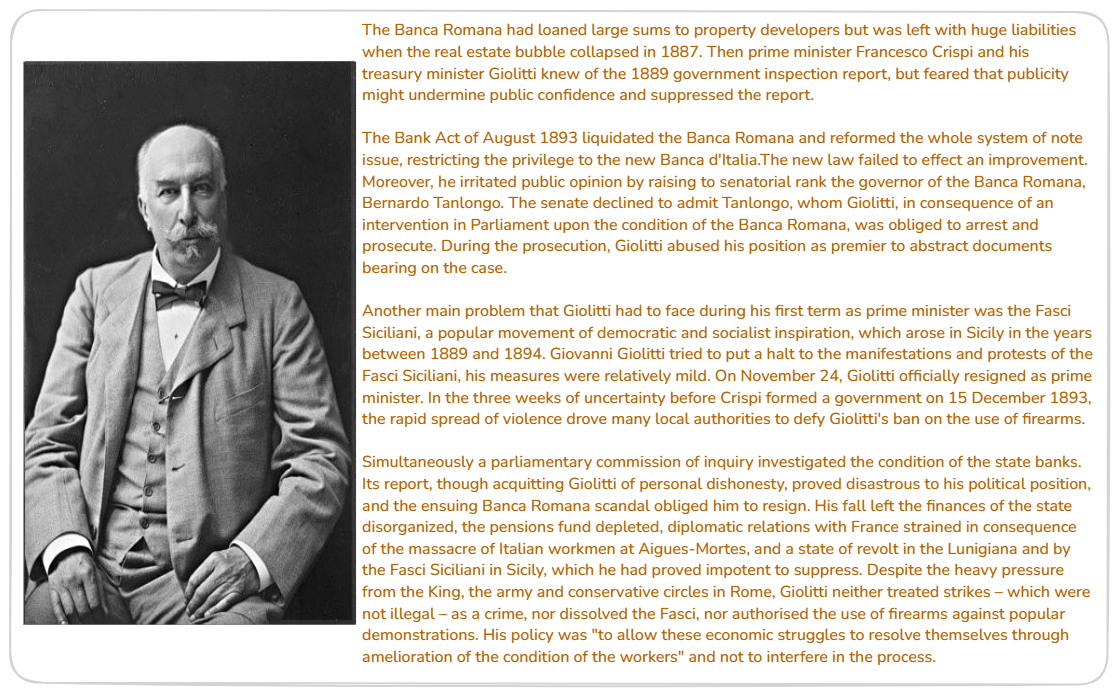
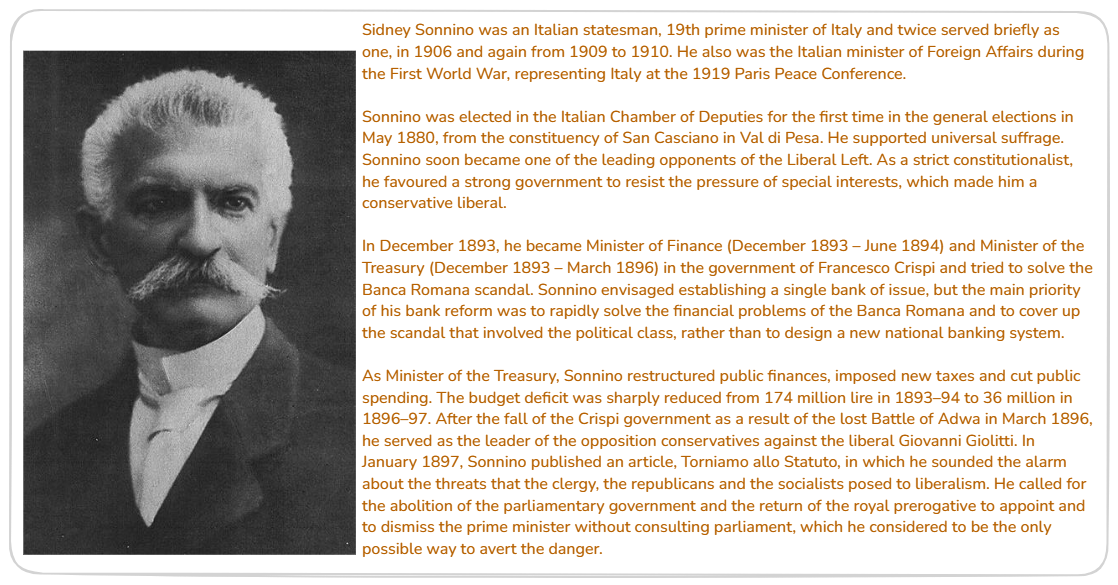
The Formation of Giolitti's First Cabinet
"Giolitti’s first government was premature. For all his authority on budget matters, Giolitti was not considered an authoritative figure in parliament. In contrast to Agostino Depretis or Francesco Crispi or Giuseppe Zanardelli, he had risen very rapidly. Consequently, he was surrounded by men who felt that their claim to power was superior to his. The new ministry was a creation of the crown and was sustained from the beginning by royal favor. Giolitti’s efforts to create his own political base through new elections proved illusory, and his management of the elections and the subsequent banking scandal attached an aura of scandal and corruption to his name that would never completely dissipate. Yet despite all the negatives, the first ministry provided a glimpse of the future Giolitti. As interior minister he revealed a mastery of the electoral machinery. He also traced a new direction in dealing with labor unrest. Nonetheless, in late 1893, amid the wreckage of his government, it was hard to see that Giolitti would ever have another chance as prime minister.
Giolitti drew his first government from a minority of the liberal left: Zanardelli’s followers, the Giolittians of Piedmont, some Southerners like Pietro Lacava and the Neapolitan Pietro Rosano, and part of the extreme left. Vital to success was the backing of King Umberto I, who immediately settled on Giolitti, once he received assurances about the military budget and the reappointment of Luigi Pelloux and Simone de Saint-Bon, the two military ministers. Crispi’s heavy-handed attempt to block Giolitti by advising Umberto that the presidency of the Council of Ministers had to go to someone of the stature of Bismarck in Germany, not to an untested political unknown, only made the monarch more resolute. Other leaders were hardly more enthusiastic, but in the end, Urbano Rattazzi’s influence with the king was decisive.²
The process of forming a government, an arduous task for anyone, was particularly daunting for a newcomer in a weak position. Despite his ten years in the Chamber of Deputies, Giolitti’s colleagues considered him relatively young at age forty-nine and looked down on him as the first leader with no ties to the Risorgimento wars.³ The composition of the government was at the mercy of forces that Giolitti did not control. The monarch traditionally chose the military ministers. Giolitti could do nothing about the opposition of an embittered Crispi on the left and a split on the right between Antonio di Rudinì and a newly emerging group headed by Sidney Sonnino.
As an unorthodox left liberal, Giolitti reached out initially to those who supported his economic program. Sonnino assured him that his friends had decided on a conciliatory approach to Giolitti’s efforts.⁴ Sonnino even suggested the names of several Southern senators as ministers of justice and agriculture. Giolitti did offer the treasury ministry to the conservative Senator Costantino Perazzi and sounded out both Sonnino and Antonio Salandra about joining his government. Sonnino rejected the important public works ministry but couched his refusal in terms that reflected a concern not to complicate Giolitti’s task. Given their long rivalry, a Giolitti-Sonnino cabinet might have been an interesting experiment but, as Giolitti’s collaboration with Crispi indicated, acceptance of a cabinet post was not a pledge of eternal fidelity.⁵
Giolitti was quite aware of the need to have Southerners in the government. The Tuscan Ferdinando Martini, who received the ministry of public instruction, suggested that Giolitti approach Crispi to ease potential opposition. Pressed by two Southern crispini, Justice Minister Teodorico Bonacci and Minister of Posts Camillo Finocchiaro-Aprìle, the most Crispi would promise was to absent himself for the vote. Roux wrote to the president of the Banca Nazionale, Giacomo Grillo, to assure him that Lacava, a Southerner with ties to the bank and to Crispi, would get the ministry of agriculture, commerce and industry. Right leader Rudinì wrote to Luigi Luzzatti that he could not enter the Giolitti government “without demolishing myself and the party,” but that Giolitti on the left would be “a moderating element; on the right he would be uncomfortable.”⁶
At the end of the process, on May 25, 1892, Giolitti presented a weak and unstable government to Parliament. He held the presidency and the interior ministry with the Neapolitan Pietro Rosano as undersecretary. Benedetto Brin, a rival who had opposed Giolitti as navy minister under Crispi, became foreign minister. Vittorio Ellena was finance minister; Teodorico Bonacci, a friend of Crispi, was appointed justice minister (without softening the former prime minister); Ferdinando Martini, openly contemptuous of Giolitti, joined the government as minister of public instruction; the Southerner Pietro Lacava was confirmed as minister of agriculture with the conservative Sicilian Antonino Di San Giuliano as his undersecretary. The appointments of the Sicilian Camillo Finocchiaro-Aprìle as minister of posts and Francesco Genala as minister of public works rounded out the appointments that were controlled by Giolitti. General Pelloux and Admiral Saint-Bon remained as war and navy ministers, respectively.⁷
Giolitti offered budget reductions, administrative reorganization, and continuity in foreign policy. His refusal to consider new taxes cost the support of Sonnino, who believed that the new government was playing with numbers. The left disliked Giolitti’s acceptance of military ministers imposed by the king and the cautious program of reform; the right saw a weak, left-liberal ministry, destined for a very short life. The outcome of the confidence vote on May 26 was razor thin, 169 to 160, in favor of the government. Giolitti immediately announced his resignation, which the king refused to accept. Umberto then consulted with Rattazzi and Domenico Farini, both of whom favored dissolving the Chamber of Deputies and calling new elections, but only after Giolitti took care of immediate business.⁸ In June, when Giolitti asked for provisional spending authority for six months, the vote was 261 to 189, a wider margin than in May. Giolitti kept the support of those who counted. Rattazzi telegraphed his congratulations, and the king informed Farini that he had never realized that Giolitti was “so calm, tranquil, that by now it could be said that he had won a great success.”⁹ Other comments on the new government were less generous. The prefect Alessandro Guiccioli, a conservative with few kind thoughts about Giolitti, noted in his diary: “Finally, Giolitti has completed his mediocre government. He wanted to give it an air of the Left, as much because it gave the impression of doing something and out of respect for that rancid and stupid notion of two great parties.”¹⁰
More ominous, because it represented deeper ideological and intellectual convictions, was the reaction of the emerging group of free-market liberals: Vilfredo Pareto, Maffeo Pantaleoni, Arturo de Johannis, Luigi Einaudi, Ugo Mazzola, and Antonio De Viti De Marco, who in 1890 bought the prestigious Giornale degli economisti, which the group turned into the mouthpiece for economic reform. In 1891 they brought together free-trade conservatives like the Milanese industrialist Giulio Prinetti, who financed the conservative Roman newspaper Fanfulla and the periodical Idea liberale, together with Radicals like Edoardo Giretti and Antonio De Viti De Marco.¹¹ The liberisti (advocates of free-market economics) linked the battle against tariff protection with a campaign to purify political life. After the turn of the century, Luigi Albertini opened his Corriere della sera to them, as did Socialist Filippo Turati, whose journal Critica sociale espoused free trade on grounds that an end to tariff protection would benefit the working class by lowering prices for basic commodities. **Southerners who associated themselves with the liberisti, like the young Francesco Saverio Nitti and Giustino Fortunato, saw the destruction of protected interests as a step toward reforming and modernizing the South.**¹²
From the start the liberisti sensed an enemy in the pragmatic Giolitti. Free traders like Pareto viewed the composition of the new government without much hope: Pelloux and Brin symbolized high military budgets, Minister of Public Works Genala had negotiated the much criticized railway conventions, and Giolitti had already bailed out several banks. Privately, Pareto felt that Giolitti had spread himself too thin in order “[t]o content everyone: the Court, the chauvinists, the taxpayers, the economists, and the big spenders.”¹³
The 1892 Elections
Once parliament recessed, Giolitti proceeded with his plans for dissolving it, but he still faced vexing problems. In July, when Finance Minister Ellena fell ill, Giolitti again tried to broaden his coalition to the right by approaching Perazzi, but Perazzi’s price was 20 million lire in higher taxes. He admitted that this was not what Giolitti wanted to hear: “I am well aware of the quite serious reasons why you and your colleagues in the ministry cannot, in this moment, take as your own these conclusions of mine.”¹⁴ A wiser Giolitti then turned to the tractable Bernardino Grimaldi, Giolitti’s predecessor in the Crispi government who had been associated with tax increases that Giolitti opposed. On July 8, Farini noted in his diary: “This nomination seems to me to be the first false step and might be an indication of weakness.”¹⁵
It is tempting to read back into Giolitti’s early career a political mastery that did not exist in 1892. In calling for new elections, Giolitti embarked on an ambitious strategy, but he was far from the accomplished politician of a decade later. Moreover, he had to contend with considerable pressure from such allies as Brin and Zanardelli, his political equals or superiors, and from Rattazzi and the king, who monitored his every move. Zanardelli’s plans, especially, often conflicted with Giolitti’s, and when that happened, his senior colleague reminded Giolitti that Zanardelli had offered help in forming the government “even against the advice of some among our most authoritative friends in the party.”¹⁶ Rosano, Zanardelli, and Lacava worked to keep the ever dangerous Crispi relatively neutral during the election period. Rosano reported that at a dinner he arranged with Crispi, deputies Zanardelli, Ferdinando Martini, and Roberto Talamo Senise, described Crispi as “serene and benevolent”; the prefect of Naples, Tommaso, and then repeated, “Don’t have me attacked by your newspapers.”¹⁷
Relative strangers intruded with advice. In June, Giolitti and Justice Minister Bonacci received an unwelcome suggestion from the grand master of the Freemasons, Adriano Lemmi, who pressed the government to pay the clergy through the state’s Fondo Culto and to finance those payments by liquidating the assets of local parishes. Once paid by the government, priests could no longer afford to be hostile to the state. Bonacci wrote to Giolitti the next day: “It appears to me to be highly inopportune and dangerous to raise this question at this time.”¹⁸
Even without unwanted suggestions, the election was an enormous undertaking. The electoral law had been modified by the elections of 1882, 1886, and 1890, in which candidates from the proportional system used in colleges. In 1892 Italy returned to the single-member constituency system with two rounds of voting. The new law put pressure on the administrative apparatus of the Interior Ministry, starting with the prefects in the provinces, and on the government’s political operatives to find candidates who fit the local circumstances. At Zanardelli’s urging, Giolitti moved aggressively to shift around prefects appointed by Nicotera during the Rudinì government.¹⁹ Rosano tried to calm Zanardelli’s fears of failures in preparation by assuring him that even if the prefects could not be moved, special delegates from the Interior Ministry would be sent to take control of local situations.²⁰
Giolitti made changes in June, July, and August in about thirty-five of the sixty-nine prefectures, mainly in the South. Many of the most important ones (Ancona, Bologna, Florence, Genoa, Messina, Milan, Modena, Padua, Pavia, Pisa, Rome, Turin, Verona, and Vicenza) were left undisturbed, although he did shift the prefects of Naples, Venice, and Palermo.²¹ Despite the seemingly large number of transfers, Giolitti was no more heavy-handed than Crispi had been (and would be in 1895) or than Pelloux would be in 1900. Moreover, many powerful prefects could not be moved easily by a weak government, despite Giolitti’s doubts about their abilities and loyalty. A difficult case was the conservative prefect of Florence, Count Alessandro Guiccioli. Giolitti suggested that something could be arranged with the Foreign Ministry: “Moreover, he declared to me most frankly, albeit with courtesy, that he would understand it if I found it uncomfortable to remain in Florence during the elections.” As it turned out, Giolitti had little leverage with Foreign Minister Benedetto Brin. When Guiccioli went to Brin, he was told that nothing was open. In the end, Guiccioli remained in Florence and was replaced only in March 1893, by Count Guglielmo Capitelli.²² Problems also arose in Milan, Reggio Emilia, and Verona, where the prefects had been associated with opponents of the government but were too influential to be moved easily. In Milan the conservative Count Giovanni Codronchi finally resigned in February 1893, but the equally conservative Angelo Winspeare shifted from Turin to take his place.²³
The quality that Giolitti liked in a prefect was the willingness to execute orders even at some risk. But under these conditions, especially during a period of transition from one government to another, the life of a prefect could be quite stressful. In June, Saverio Conte, about to be removed as prefect in Zanardelli’s Brescia, appealed to Benedetto Brin: “If you can and want, Excellency, see if you can let my minister [Giolitti] know that you like me. I am in the frying pan and I do not know how I will escape being cooked.” Things went well enough while Zanardelli was in opposition, but now that he was again influential, it was all over and “Conte has to go elsewhere to find some cat to skin. Fine justice, my usual fate. Meanwhile, in less than five years (August 1887) [I moved] from Livorno to Cuneo, from Cuneo to Palermo, from Palermo to Naples, from Naples to Reggio Emilia, from Reggio Emilia to Brescia, from Brescia to? With a family of eleven, repeat eleven!”²⁴
While the Interior Ministry pored over lists of candidates for the various colleges to find the best one to support, **the prefect had to persuade weaker candidates, even sitting deputies, to stand down. One way of dealing with inconvenient candidacies was appointment to the Senate. This took place in several ways. Opponents of the ministry could be moved out of the way. Supporters of the government also received nominations to make way for new men, either because they were tired of electoral campaigns or because the nomination was requested by a friend of the government. For instance, Giolitti nominated the deputy Luigi La Porta to the Senate because he was ill and could not win another campaign. In all, Giolitti appointed about sixty new senators before and just after the elections.²⁵ In September 1892 Farini heard the rumor that the quality of the upcoming nominees would be poor. When the official list was passed from Rosano to Farini on October 11, the Senate president objected strongly to the deputy Francesco Zuccaro-Floresta from Sicily, who had been accused of being a spy for the old Bourbon monarchy.²⁶ In most cases the candidates were less controversial, although the process was fraught with politics. For instance, the deputy Giuseppe Pugliese requested that Baron Nicolò Melodia be nominated for the Senate. However, the newly appointed prefect of Bari, Bernardo Carlo Ferrari, suggested that Melodia be included in the list only after the election, noting: “He who pays first is badly served later.” Ferrari suggested that Giolitti “make it clear that the government supports only those who back its candidates, especially in Trani.”²⁷
If the primary objective in the elections was to achieve a solid majority for the government, the secondary aim was to weaken and divide the extreme left, even if it meant victory for conservatives who were not overly freindly to Giolitti. Pietro Rosano, Giolitti’s undersecretary at the Interior Ministry, worked to defeat Radical candidates Felice Cavallotti, and Renato Imbriani. Cavallotti lost in the college where he had won six previous elections; both elections were eventually annulled, however, and the two Radicals were returned to parliament. The undenounced first-time Socialist candidate Napoleone Colajanni considered with opposition but received a loan from Vilfredo Pareto in the face of government Colajanni returned the favor by bringing the Banca Romana scandal before the Chamber of Deputies.²⁹
The Socialist organizer of the working-class organization (fascio) in Catania, Sicily, Giuseppe De Felice Giuffrida, an opponent of Crispi on the island, ran in the city’s second college. He was also a rival in city politics of Agriculture Undersecretary Antonino di San Giuliano. During the electoral campaign San Giuliano pressed for a more vigorous effort to defeat De Felice Giuffrida. Aid came in the form of increased hiring at the government cigarette factory, more public works projects, and sufficient funds to be channeled through the prefect, but San Giuliano also wanted Giolitti to make clear that he actually opposed De Felice. In fact, the government’s position was ambiguous, perhaps because De Felice was so clearly anti-Crispi. The prefect of Catania, Emilio Caracciolo di Sarno wrote to Rosano that the Socialist won despite his best efforts, and expressed satisfaction that in other races the anti-subversive line held.³⁰
In Bologna, where the government supported local conservatives against the more radical slate favored by the Bolognese newspaper, Resto del Carlino, the right took three seats. An accommodation of sorts existed between the government and the Socialist Andrea Costa, who continued to believe in Giolitti’s progressive attitudes. However, against Gregorio Agnini, another Socialist who enjoyed relatively good relations with Giolitti, Prefect Vincenzo Arata of Modena unsuccessfully tried to organize an alliance of moderate and progressive liberals that, he felt, would certainly carry the day against Agnini’s coalition of Socialists, Republicans, and “malcontents about everything.”³¹ As it turned out, the government managed to hold the line against most Socialist and Radical candidacies. Filippo Turati was beaten in Milan, and even Costa lost his seat in Imola; Agnini, Camillo Prampolini, Agostino Berenini, De Felice, and Colajanni survived.
Giuseppe Zanardelli naturally took a strong interest in the outcome of the elections in Lombardy and in the Veneto. He pressed more consistently than Giolitti for left liberal, Radical, and even Republican candidates, like Salvatore Barzilai, who ran in Rome’s fifth college.³² In Milan the Lombard conservatives decided to take on the Radical candidates Luigi Rossi and Giuseppe Mussi, who appealed to Zanardelli for support. Zanardelli then made his displeasure with Codronchi, a well-connected senator, clear to Luigi Roux, who reported back to Giolitti that Codronchi, who backed the incumbent deputy and ex-mayor of Milan, Ettore Ponti, against Rossi in Milan’s fifth district.³³ To block Ponti’s candidacy, Giolitti enlisted the aid of Rattazzi and even of the king: “His Majesty still hopes that these gentlemen will reconsider before embarking on a course which will lead them into open conflict with you [Giolitti], and I have faith that some advice passed on by a trusted person to Codronchi will second this rethinking.”³⁴
Giolitti spared neither time nor money to ensure newspaper support. With Benedetto Brin on his side, he won the backing of the two major papers of Turin.³⁹ The government usually funneled requests for funds through the prefects. One from the king that could not be turned down came via the prefect of Milan, Codronchi, and Urbano Rattazzi. Umberto wanted help for Leone Fortis, editor of the Milanese Il Pugnolo, who requested, if not a regular subsidy, at least a single payment to bail out the paper.⁴⁰ On September 11, 1892, Rosano reported that the prefect of “Teramo wanted 1000 lire for a newspaper and the prefect of Naples needed 14,000 lire.” Rosano asked if Giolitti could honor both requests.⁴¹
Of course, these outlays strained the funds of the Interior Ministry and forced the government to turn to friendly banks. The ever obliging governor of the Banca Romana, Bernardo Tanlongo, wrote to Giolitti that he was doing all he could to meet the prime minister’s request for assistance on behalf of Colonel Frosinone.⁴² Use of funds from the highly suspect Banca Romana was part of a larger pattern. Giacomo Grillo, the president of the Banca Nazionale, wrote to the directors of the branches that the bank needed to remain outside the electoral campaign, but he also recalled that the administration of the bank “desires that with the prefect and with the greatest caution, work in agreement are friendly to the government.”⁴³ When the bank did not line up with the government, it brought a strong reaction. Giolitti wrote to Grillo about the conduct of the branch in Foggia, which “gives and will later give rise to unpleasant consequences.” Grillo reacted immediately to stop support for candidates opposed by Giolitti and Rosano.⁴⁴ When the vagaries of Southern politics led local bank officials in Siracusa to back the opposition, Grillo ordered the branch to stop working against the incumbent.⁴⁵
Giolitti’s own campaign in the college of Dronero reflected the same minimalist program that he had set forth eight years earlier, when he first entered parliament: a balanced budget, reduction of expenditures, no tax increases, yet maintenance of the military and foreign policy commitments of Italy. One issue that Giolitti did not raise was that of banking reform, though Rattazzi urged him to take on the issue, which was due to come up before the new parliament when the extension won by Rudinì expired.⁴⁶
The New Chamber of Deputies
The elections of November 13, 1892, ended in a great, but typically ambiguous, victory for the government: 227 of 244 left liberals favored the government; all thirty-one seats of the center-left and forty-nine of sixty-four seats of the center-right were won by candidates with government support. The core of the opposition came from the right, where only fifteen of seventy-six deputies favored the government. The Estrema (Socialists, Radicals, and Republicans) had twenty-nine opposition seats, but twenty-seven legalitarian Radicals who favored the government also won. Regionally the governmental candidates swept the center and the South: 78 of 106 seats in central Italy and 135 of 176 seats in the South. A record 131 new deputies entered parliament.⁴⁷
Italian parliaments have often been criticized for not reflecting the “real country,” but a closer look reveals the wide spectrum of professions and occupations of the new deputies. Of the thirty-two new Giolittians in the North, eight were lawyers, only two were aristocrats, and one was from the military. The balance were engineers, landowners, academics, and journalists. In the center (excluding the Abruzzi), five of the twenty-two new Giolittians were aristocrats, one was from the military, six were landowners, four were lawyers; one magistrate, a doctor, a journalist, and several professors filled out the contingent. In the South there were fifty-three new Giolittians, almost as many as in the other regions combined. These numbers indicated both a purge of the old clienteles of Nicotera, who had run the 1890 election, and the arrival of a new middle class. Among the class of 1892 were important future Giolittians like Gaspare Colosimo, Beniamino Spirito, and Leonardo Bianchi. Almost half (twenty-four) of the Southern Giolittians were lawyers; thirteen were landowners (several of whom were aristocrats), five were doctors, two were engineers, and three were professors.⁴⁸ Despite the seemingly overwhelming government victory, a three-headed monster was created with Giolitti, Zanardelli, and Crispi controlling parts of the majority. In the South many crispini passed as supporters of the government. In Lombardy, Zanardelli and his followers were victorious, not the Giolittians. In Piedmont the followers of Benedetto Brin competed with those of Giolitti.⁴⁹
Problems, like impecunious relatives, sought out Giolitti. Immediately after the elections, he offered the presidency of the Chamber of Deputies to Zanardelli, who promptly refused, then relented under prodding by the king; clearly, however, the Brescian leader felt no loyalty to the head of government.⁵⁰ If Zanardelli was merely reluctant, Brin was downright hostile. The anti-Giolittian prefect of Florence, Guiccioli, reported that Brin thought it unlikely that Giolitti could govern for long: “It is evident that Brin thinks of becoming the head of government, tripping up the present head and bringing together a majority composed of the Center and the Left much like the majority that backed Depretis.”⁵¹ Giolitti forced a first motion of confidence on December 16; he won by an overwhelming 296 to 82 vote, with only the right and the extreme left voting against. Significantly, Crispi absented himself and Sonnino left the chamber before the vote.⁵²
Tanlongo and the Banca Romana
The most direct challenge to Giolitti came from the Senate. Giolitti made only one early nomination, that of his friend Lazzaro Gagliardo on June 5, 1892. Before the elections he submitted nineteen names, probably no more than his predecessors.⁵³ The process of nomination was complex. Prefects, deputies, cabinet ministers, and the royal palace could suggest individuals. Nominations were screened by the president of the Council of Ministers and the interior minister (in this case Giolitti), who might make additions or deletions. The final list went to the king. Once appointed, future senators had to be validated by the Senate. Immediately after the voting, Giolitti nominated forty-one additional senators. Among the Giolitti papers is a list of candidates with notations on place of birth, career, titles and honors, and recommender. Most of the candidates were high state officials, deputies or prefects, and members of the nobility. In almost every case something was listed under titles and honors, except in the case of deputies, and often the name of the sponsor was listed.⁵⁴
Two nominees proved controversial. The ex-deputy Francesco Zuccaro (69–57).⁵⁵ If Zuccaro’s nomination was a misstep, Bernardo Tanlongo’s was a disaster. He was nominated by Giolitti himself, who added the name in his handwriting. Tanlongo acknowledged “that the initiative has come precisely from Your Excellency.” Giolitti compounded the error in late December by appointing Tanlongo to the oversight committee on the public debt. Giolitti, misjudging the political impact of the entire banking issue, then authorized Lacava and Grimaldi on December 6 1892, to present a bill to extend the existing issue banks for another six years. The sequence of events smelled of a political deal, especially because links between the Banca Romana and Tanlongo and the Giolitti government existed on many levels. Finance Minister Bernardino Grimaldi was so close to the Banca Romana that Rattazzi warned Giolitti about possible countermeasures from the rival Banca Nazionale, which favored an end to the plurality of issue banks.⁵⁷
On May 5, 1892, shortly after Giolitti assumed office, Director General of the Treasury Carlo Cantoni wrote to Tanlongo to arrange a meeting between the banker and the new prime minister. Cantoni again acted as middle man on September 29 when he wrote to Tanlongo, on behalf of Giolitti, that “[Cantoni] will come to you at the Banca Romana at the time that you might like to indicate, and I hope that you will receive me very well.” Giolitti later explained that the meeting was in conjunction with the upcoming Colombian celebrations; more likely, it involved the elections. Giolitti further compromised his government by borrowing 60,000 lire from the Banca Romana. He also used Tanlongo’s assistance in the election of Colonel Giuseppe Ellena, who ran in Frosinone. In a letter to Giolitti of October 30, 1892, Tanlongo coupled help for the election of Ellena with a request to intervene with the justice minister to reduce the sentence of a prisoner. Ellena won, and Giolitti acted favorably on Tanlongo’s request.**⁵⁸
Then, on November 18, 1892, around the time that Giolitti made the nomination to the Senate, he wrote to Tanlongo, asking for a meeting. The best face one can put on this was that Giolitti was trying to persuade Tanlongo to merge his bank into the Banca Nazionale and used the nomination as senator as an incentive. The historian of the scandal, Domenico Novacco, believes that **Giolitti became overconfident because he knew that the opposition was equally compromised by its ties to Tanlongo. If so, the strategy backfired, because Tanlongo became certain that he enjoyed Giolitti’s protection, as well as that of the other politicians whom he financed.**⁵⁹
Giolitti’s decision to continue the plurality of issue banks was badly received in two quarters. The supporters of the Banca Nazionale felt deceived, but the most dangerous opposition came from the liberal economists Pareto, Pantaleoni, Ugo Mazzola, and Antonio De Viti De Marco, who, though they tended to favor the plurality of issue banks, were sensitive to the odor of corruption that hung over the Banca Romana.⁶⁰ Between the time that Senator Giacomo Alvisi was frustrated in his attempt to read his report to the Senate on June 30, 1891, and his death on November 24, 1892, he passed a copy to the deputy Leone Wollemborg. Wollemborg was in a delicate position. He was friendly with Pareto, Pantaleoni, and De Viti De Marco, but he also needed the government’s help in his reelection campaign; he therefore refused to raise the issue in parliament. He did, however, give a copy to Pantaleoni. As an indication of the tension building up around the report, Pareto, who still had not seen it in early July, warned Pantaleoni that those who were going to be damaged by the publication would stop at nothing, even assassination, to block its release. On July 16, 1892, Pareto discussed giving an analysis of the material, but not the entire report, to the Radical leader Cavallotti, whom they felt was not sufficiently adept with statistics. In his column in the Giornale degli economisti, Ugo Mazzola went even further, threatening publication of the report as early as October. The decision on December 6 to extend the banking status quo for another six years without reform was the final straw. By this time, there were at least five copies of the report circulating. Pantaleoni approached the newly elected Socialist Napoleone Colajanni, and Ugo Mazzola gave a copy to Lodovico Gavazzi, the conservative Milanese industrialist and another new deputy.**⁶¹
Giolitti had advance warning about Colajanni’s plans in an undated letter, probably written in early December 1892, from San Giuliano, but it is unclear if this was Banca Romana material: “I send you a copy of the letters that Colajanni intends to cite and incriminate in his interpellation on the elections. He says that they constitute the worst cases of corruption, that is to say what he calls collective corruption.”⁶² On December 17, 1892, Domenico Farini urged Lacava and his colleagues to stay ahead of the opposition in the Chamber of Deputies and in the Senate. **Two days later, Lacava suddenly announced to the Chamber that the government was proposing only a three-month extension of the banking system. Giolitti promised “a thorough inspection of the currently existing institutions.”⁶³
The effort to delay debate worked only partially. The next day Colajanni demanded that the results of past investigations be published. Since the Alvisi-Biagini report had been kept secret by three governments, he doubted that Giolitti would ever publish it. Lodovico Gavazzi then read excerpts from the Alvisi-Biagini report and called for a full investigation: “I do not trust the simple inspection that was announced by the honorable president of the council.”⁶⁴ Luigi Miceli, as deeply involved as Giolitti, made the astounding statement that the earlier inspectors did not find problems with the banks and questioned the accuracy of any documents: “I would be able to ask what authenticity do these papers have? I might also say that they do not exist!” At that point Colajanni shouted: “You’ve burned them.” Stung by the attacks, Giolitti made a series of errors that would cost him dearly. He accused Gavazzi of questioning his personal honor by doubting the government inspection and implied that Colajanni had stolen (and possibly altered) the documents. Giolitti denied that he had even read the original Biagini report, “because neither honorable Miceli nor the other ministers who were in power at the time gave it the exceptional importance that now, after so much time, one would like to give it.” He then called for a vote of confidence. At that point, not only was Giolitti’s conduct called in question, but also that of Rudinì and Luzzatti, who had suppressed the report, and of Crispi before them. The result was a foregone conclusion and the three-month extension passed, 316 to 27.⁶⁵
In an effort to put the entire affair behind him, on December 31 Giolitti appointed Senator Gaspare Finali to investigate the banks. But the efforts to contain the scandal soon came undone. On January 12 the government informed Tanlongo that the merger of the Banca Romana and the Banca Nazionale would proceed and that he faced arrest. Needless to say, the banker was a bit shaken: “I fall from the clouds.” When Banca Nazionale director Giacomo Grillo complained directly to Giolitti about the scant cooperation he was getting from the
Banca Romana, the president of the Council of Ministers told Farini that he was ready to send a royal commissioner to take over the Banca Romana if Tanlongo rejected the merger.⁶⁶
On January 18, 1893, Finali reported to Giolitti in a meeting marked by mutual suspicion. Giolitti told Farini on January 20 that he left the meeting with Finali without knowing until the next day that an arrest warrant had been issued for Tanlongo and that a search of his home and office had been authorized. ==Tanlongo was charged with misuse of public position and of falsifying dates and serial numbers during 1891 and 1892, in order to exceed the legal limit on the issuance of banknotes by at least 65 million lire.==⁶⁷
At this point the scandal metastasized. The Rome police chief questore and public security agents searched Tanlongo’s home and that of the bank’s cashier, Cesare Lazzaroni. They seized a number of documents, including many letters from prominent politicians. Crispi and Tanlongo later alleged that Giolitti came into possession of these documents and letters when Questore Odoardo Felzani allowed the seals to be broken and an inventory made. More likely, the Tanlongo family concealed many of the documents between the time they were warned of possible arrest around January 12 and the search of the premises on January 19, in order to trade them for Tanlongo’s release.⁶⁸
The politicians panicked. No one knew what had been taken from Tanlongo and whom it implicated. Rattazzi told Farini of the rumor that Crispi’s wife Lina and Giovanni Nicotera had dealings with the Banca Romana. Bernardino Grimaldi, closest of all to Tanlongo, claimed that he had nothing to do with the bank director’s nomination to the Senate.⁶⁹ Problems spread to the Banco di Sicilia and the Banco di Napoli when the director of the latter bank was arrested. Antonio Monzilli, the official at the Ministry of Agriculture and Commerce who had been involved in the original cover-up, was implicated. Rocco De’ Zerbi, a conservative deputy from Naples, committed suicide on February 20, after being accused of the transport of false banknotes. Crispi then decided that he could best save himself by saving Tanlongo. Various comments by Giolitti to Farini, and probably to others, about Crispi must have gotten back to the Sicilian, because sometime in late January, Crispi offered to help Tanlongo in return for documents in possession of the family.⁷⁰
==Giolitti faced calls for a parliamentary inquiry into what had been a badly handled crisis. Politically, however, his options were limited by knowledge that the king opposed a full parliamentary investigation and that his own enemies targeted Urbano Rattazzi, his best ally at court.==⁷¹ Giolitti’s friend Lazzaro Gagliardo presented a very realistic appraisal of damage that the scandal could cause:
The principal [responsibility] falls on the ministers of commerce who have succeeded one another since 1890; immediately afterward comes that of the ministers of treasury, and the presidents of the Council [of Ministers] are not immune. Certainly, if criticism for our actions can be leveled at the paternal Miceli and at ourselves when we were together in 1890 at the Treasury, much more serious censure falls on Chimirri, Luzzatti and Rudinì…and your colleagues Lacava and Grimaldi merit some, although less, for their part. … Too bad that one cannot respond to these opponents (not to all, however): “watch out, for your own affairs are worse.” I agree that a defense so conceived is always a weak defense.⁷²
Giolitti held out until January 28, then won a three-month delay in setting up the committee.⁷³ In February, as the government moved ahead with the merger of the Banca Romana and the two Tuscan banks into the Banca Nazionale, which then became the Banca d’Italia, the scandal widened into a struggle between Giolitti and Crispi. By February 21, Tanlongo accused Giolitti of receiving money through Cantoni, Lacava, and Grimaldi. In a bitter debate Crispi recalled a visit by Giolitti on June 14, 1890, in which the then treasury minister criticized the Banca Romana and declared that the information uncovered was a matter of the courts implying that Giolitti knew the contents of the Alvisi-Biagini report. Crispi argued that he had favored the unification of the banks then, but was opposed by his government.⁷⁴
With his own proposal for the reorganization of the banks now in hand, Giolitti accepted an investigative commission of seven members set up with a very broad mandate. But the committee itself posed problems. Antonio Mordini, a veteran politician of the Historic Left and a friend of Crispi, headed it. Antonio di Rudinì’s friend Cesare Fani; another conservative, Gianforte Suardi; and Giovanni Bovio of the Estrema opposed Giolitti. Clemente Pellegrini, Alessandro Paternostro, and Emilio Sineo tended to be neutral or favorable to the prime minister. Mordini’s vote was often crucial, and it went against Giolitti.⁷⁵
The Unmaking of a Government
A much weakened Giolitti government emerged from the initial crisis. Both the Giolitti and Crispi-Tanlongo camps leaked documents to the detriment of both politicians. Public Instruction Minister Ferdinando Martini suggested resignation of the entire cabinet. Justice Minister Bonacci was restrained from doing just that only after the king intervened. Grimaldi, Pelloux, Lacava, and Brin were poised to defect. The Senate was in open revolt against the “lowly clerk” (l’impiegatuccio). ==Giolitti finally gave up after losing a procedural vote, and a brief search for a successor ensued.==⁷⁶ He survived only because King Umberto found the alternatives more unpalatable than his current prime minister. Giolitti reorganized his cabinet, but his bad luck continued. Almost immediately after his appointment, Justice Minister Lorenzo Eula died; his replacement publicly stated that he had been forced to join the government and might vote against its budget.⁷⁷
At the end of June, the bank reorganization moved through Parliament. Four Northern banks formed the new Banca d’Italia, and the Banco di Napoli and the Banco di Sicilia continued operations. Oversight of the system passed from the Ministry of Industry and Commerce to the Ministry of the Treasury. Penalties were imposed on the banks for any excessive issuance of currency. The Banca d’Italia had twenty-five years to bring circulation within legal limits by retiring the paper of the old banks. Critics of the project objected to the generosity shown to stockholders of the Banca Romana, to the illogicality of a system of three issue banks, and to the long period for the liquidation of the old currency. Sonnino, who suggested letting the Banca Romana collapse, wanted a single central bank that would engage in a major reduction of the money supply.⁷⁸ Giolitti responded that Sonnino’s drastic solution would ruin the religious, charitable, and municipal institutions that had deposits with the Banca Romana, and that a sharp cutback in the money supply would harm the building and agricultural sectors. Regional considerations also played a role in the formulation of Giolitti’s compromise plan. ==Northern, especially Lombard and Ligurian, banking interests wanted centralized control to pass to the Banca Nazionale at the expense of the Southern and Roman banks. Giolitti supported the Bank of Naples against such a concentration of power.==⁷⁹
The Sicilian Fasci and the Rise of Socialism
After passage of the banking legislation, Giolitti’s opponents seemed divided on the government’s chances of survival. Prinetti’s judgment of late August expressed the growing discontent among hard-line conservatives: “General policy is going very badly; abroad it is absurd, at home it [has] led to the most terrible moral disorder that has ever existed in Italy.”⁸⁰ Prinetti referred not just to financial and banking scandals when he spoke of disorder. The growth of working-class organizations that had taken place in 1892 and 1893 concerned him. In October 1892, in Genoa, worker organizations representing over 200,000 founded the Italian Socialist Party. In Sicily the rapid growth of worker organizations, the Fasci Siciliani, presented an even more disturbing phenomenon. Peasant protest appeared in 1890 and 1891 during Crispi’s administration, then spread to the sulfur mines and to the major cities and towns on the island. Crispi did not make these organizations a major issue, but a growth spurt in 1893 changed everything.⁸¹
Giolitti had tolerated the growth of both the Fasci and the Italian Socialist Party. Two principles governed his attitude on labor relations. He never wavered in his belief that the existing institutions could control pure labor agitation because economic struggles would resolve themselves through improved working conditions. The government needed to maintain order and to persuade the parties to compromise. Granting worker cooperatives the right to compete for public contracts fit in with the strategy of co-opting moderate labor organizations.⁸² In December 1892, Giolitti responded to a conservative Sicilian deputy that “Our legislation does not consider a strike in itself a crime.” As long as the workers “did not offend the freedom to work of the other workers and limited themselves to strike to obtain better conditions from the owners, the political authority does not have reason to impede these workers in the exercise of their right.” He also cautioned that “The police have the duty to intervene to guarantee to the other workers the right to work.”⁸³
Giolitti’s second guiding principle was to avoid exceptional repressive measures by rigorously applying existing laws. Existing legislation was adequate to protect strikers and to handle disorders in the face of unrest. “I do not believe that exceptional measures are necessary, but all means that the law allows I will apply inexorably.”⁸⁴
After May the banking scandal and discontent within the political class over worker unrest became linked. In January 1893 the conservative deputy Boldes-sare Odesscalchi connected the Banca Romana with the growing disorders on both left and right. By May the government was under increasing pressure from both Moncaldi di Pareo implied that criminal elements had infiltrated the peasant leagues and made their agitation more dangerous. Colajanni bitterly attacked the government’s overall record on civil rights: “I have stated at other times in parliament that in my opinion political parties in the future will apply exactly their way of understanding the solution of social questions. I have always believed and I believe that the role of the modern state goes far beyond what the classical economists believe"
Throughout much of 1893 Giolitti tried to reassure the economic and political establishment that he had the security situation well in hand, but during the summer he was forced to crack down on the leadership of the Fasci. In June and August he asked the prefects for lists and records of all members of the Fasci, in order to determine if any members had criminal records or Mafia connections, but he did not move to suppress the entire Socialist organization.”⁸⁵ As usual bad luck plagued Giolitti. In mid-August, at Aguglia-Mortes, French workers brutally attacked Italian migrants. Not only were Giolitti’s attempts to smooth relations with France set back, but sympathy protests by workers in Rome and Naples further unnerved the king and the conservatives. Pressure on the government mounted by September the strike movement in Sicily expanded. The prefect of Palermo, Vincenzo Colmayer, advised the suppression of the peasant leagues. Rattazzi informed Giolitti that an increasingly impatient Umberto would meet with Giuseppe Senales, the director of public security, about the Fasci. “He will not be silent about his hope to see that at least now some measures be taken on the burning issue.” In October, Senales was sent to Sicily, ostensibly to collect information but in reality to prepare for the arrest of the Fasci leaders.⁸⁶
A Miserable End
The report of the Committee of Seven on the Banca Romana scandal delivered the final blow. In his testimony in May and September,== Giolitti denied the charges that had been brought against him. He insisted that the 60,000 lire from the Banca Romana was for the Columbus celebration, not for the elections, and absolutely denied receiving another 40,000 lire from the bank or knowing of the contents of the Alvisi-Biagini report. Finally, he rejected any connection between Tanlongo’s nomination to the Senate and his bank’s aid to the government. Crispi’s testimony directly accused Giolitti of pressuring Grillo of the Banca Nazionale to find out about an 1887 loan from that bank to Crispi that had not been repaid, and Grillo acknowledged that he had felt some pressure from the prime minister.⁸⁹
On September 30, 1893, the correspondent of Il Secolo, Giulio Norsa, wrote to the Radical deputy Giuseppe Marcora that the government looked relatively strong as long as Zanardelli and his allies held firm. Within a week Zanardelli, who was being actively courted by Sonnino, proved him wrong. On October 2, Rattazzi announced to Giolitti that none of Zanardelli’s allies would attend Giolitti’s political banquet scheduled for later in the month.⁹⁰ Two days later, Rosano wrote to Giolitti that Lazzaro Gagliardo would resign. The loyal Gagliardo argued that the government should choose the moment to go rather than be voted out by the Chamber of Deputies; then the king could either ask Giolitti to form another government or turn to Zanardelli with Giolitti as president of the Chamber. Giolitti probably would have followed this advice, but the king insisted on October 13 that he present his program to parliament for a full discussion and vote.⁹¹
Once the king foreclosed resignation, Giolitti had no choice but to follow Roux’s advice to fall on an issue of principle, thus preparing for his return to power. On October 18, at Dronero, he called for a progressive tax on incomes, rising from 1 percent on incomes above 5,000 lire to 5 percent on incomes of over 100,000 lire; new inheritance taxes; and reforms to catch tax evaders. Although roughly 248 deputies and 70 senators subscribed to the political banquet, Farini did not believe that Giolitti’s standing would improve by frightening the wealthy.⁹²
Sonnino led the attack on the government. The Tuscan leader offered his alternative program on October 28. He mercilessly attacked the banking law for allowing three deeply compromised institutions to remain active and for bailing out the Banca Romana at taxpayers’ expense. But Sonnino reserved his harshest criticism for the new tax proposals. He accused Giolitti of raising dangerous issues of “reverse proportionality” and discrimination against the poor in a moment of great social tension. He feared that the state’s inability to tax forms of mobile wealth meant that the burden of any tax increases under Giolitti’s proposals would fall on urban and rural landowners whose property could easily be estimated, thereby increasing the inequalities within classes. Sonnino proposed instead a comprehensive program of assistance to rural Italy: reform of agrarian contracts to give more protection to peasants, limits on interest payments on peasant loans, and expansion of the sharecropping (mezzadria) system. It was a message of social solidarity in troubled times.⁹³
Giolitti and Sonnino seemed to approach the problem of uneven distribution of wealth in Italy differently. Giolitti argued for a better distribution of incomes by reducing the wide variations between regions and classes; Sonnino, though admitting the need for social reform, saw nothing wrong with the accumulation and concentration of wealth, provided the overall tax system operated fairly. But these differences proved illusory in the long run. Giolitti never acted on any major tax reform before the issue began to fade after the turn of the century. His solution, in practice, was to cut expenditures and to remove the pressure of state borrowing from the financial markets. In fact, Sonnino was far more capable of envisioning sweeping and fundamental reforms, whereas Giolitti preferred administrative changes and financial operations, such as the 1904 debt conversion, to ensure a margin for reform. Giolitti’s real contribution was to open the system to allow more groups to compete for economic opportunities.⁹⁴
The Fall of Giolitti's First Government
In November, just as Giolitti’s majority was disintegrating, there was a run on the Credito Mobiliare, Italy’s major institution for ordinary credit; it collapsed a few days after the new session of parliament opened on November 23.⁹⁵ The report of the Committee of Seven was ready. Imbriani and Cavallotti, who seemed to know the contents, demanded its immediate distribution. Giolitti could do little but support the motion. The conclusions were devastating. Both Miceli and Giolitti were singled out for suppressing the Alvisi-Biagini report in the interests of protecting Italian credit. The committee felt that Miceli, Giolitti, and Crispi lied about not having been fully aware of the serious problems at the Banca Romana. The Rudinì government was also criticized for ignoring evidence that illegal currency issue had been discovered. The committee left open the possibility that the Tanlongo family held back documents and that Giolitti had not tampered with the evidence.⁹⁶ As for the loans made by the Banca Romana to the government around the time of the elections, the report found Giolitti’s explanation unconvincing but could not resolve conflicts between Tanlongo and Giolitti: “On a matter of such gravity, to prove one way or another demands conclusive evidence. The commission concludes: Not proven.” The “not proven” verdict would haunt Giolitti for a decade.⁹⁷ As a shaken Giolitti resigned the next day, Imbriani shouted, “You roll in mud!” Giolitti fired back, “Honorable Imbriani, no matter how much you try, you will never succeed even in throwing mud on my boots.” Imbriani, unwilling to let the matter die, shouted, “You have it right in the face!” At that point the session of the Chamber of Deputies was suspended to await the decision of the king.⁹⁸
Giolitti's First Government: An Assessment
A series of mishaps, compounded by lies and confusion, plagued Giolitti’s first administration. Some things were not his fault. In foreign policy he worked to improve relations with France, only to see his efforts collapse with the killings at Aigues-Mortes. The opening to the working class snapped shut as the agitation in Sicily grew more serious. But ==Giolitti also dug his own grave. He failed to manage the banking crisis and offered a partial reform only under pressure. The final bank reform was the work of Sonnino, who emerged as the leading political figure of the rising generation. Even more costly, Giolitti damaged his relations with Umberto I, who concluded that his former prime minister was weak and ineffectual.==⁹⁹
Giolitti’s failure proved costly to his friends. Urbano Rattazzi was dismissed as minister of the royal household when Crispi formed his new government. Luigi Roux lost his seat in the 1895 elections. Lazzaro Gagliardo retired from active politics. Even Zanardelli, who had been encouraged by Sonnino to expect the succession, came up short. The king reluctantly offered the mandate to Zanardelli, but used Zanardelli’s insistence on his choice of foreign minister to eliminate the Brescian leader. Umberto then turned to Crispi, whose selection meant the exclusion of the remaining Zanardellians and Giolittians from the new majority. To compensate, Crispi reached out to Sonnino, Giuseppe Saracco, and Paolo Boselli on the right.==¹⁰⁰
In judging Giolitti’s first government, it might be unfair to concentrate only on the failures. The government did pass pension reform, laws on local roads and water projects, new tariff conventions, and improvements in the status of elementary school teachers. More important, Giolitti made a breakthrough in the direction of the democratic left.¹⁰¹
During his first government Giolitti revealed his mastery of the state bureaucracy.¹⁰² If he stumbled in the larger political arena, he showed himself to be a born interior minister who could be merciless when the occasion demanded. When the Radical deputy Giuseppe Marcora requested the appointment of a prefect whom Giolitti judged below average, the president of the Council of Ministers fired back: “Lugana has shown that he does not have the necessary qualities to be a prefect and I cannot take on the responsibility to entrust him with another province.”¹⁰³ Efforts by prefects to impose conditions on Giolitti were most often firmly rejected. Political weakness initially kept Giolitti from acting against powerful prefects like Codronchi in Milan and against Antonio Winspeare, but when the able Gennaro Minervini refused to accept a transfer, Giolitti threatened to demote him: “If we do not make examples, administration is no longer possible.”¹⁰⁴
Difficulties with some prefects pointed to a larger problem. Even after his great electoral victory, Giolitti did not fully control a majority in parliament. Powerful rivals on the left like Crispi, Brin, and Zanardelli, all senior to Giolitti, thought they had a better claim to the presidency of the Council of Ministers. From the start Giolitti’s ministry was totally dependent on the king, in whose interest Giolitti’s ministry was totally dependent on his political fortunes. When he returned to office after the turn of the century, many of these limitations had disappeared. But all of this was in the future, and as Giolitti left office in November 1893, his political prospects seemed all but extinguished. The immediate future belonged to Crispie, who used fears over the Fasci Siciliani to return to power.
Summary
Formation of Giolitti’s First Cabinet (May 1892)
- Giolitti formed a weak, unstable minority government on 25 May 1892 at age 49, heavily reliant on King Umberto I’s support.
- Cabinet drawn mainly from the liberal left (Zanardellians, Piedmontese, some Southerners) with key military ministers imposed by the Crown.
- Key appointments: Giolitti (Prime Minister + Interior), Brin (Foreign), Bonacci (Justice), Martini (Public Instruction), Lacava (Agriculture).
- Government survived a razor-thin confidence vote (169–160) on 26 May; Giolitti offered resignation, which the King refused.
- Program focused on budget cuts, administrative reform, and continuity in foreign policy; no new taxes.
The 1892 Elections (November 1892)
- Giolitti dissolved parliament and called elections under the single-member constituency system.
- Extensive prefect reshuffles (especially in the South) and use of patronage (Senate nominations, bank funds, newspaper subsidies).
- Government used Banca Romana funds and influence; Tanlongo assisted in several electoral efforts.
- Results (13 November 1892): Strong government victory — swept Center and South, 227/244 left-liberals supported the government. Record 131 new deputies elected.
The New Chamber of Deputies (Late 1892)
- Government secured a large majority but remained fragile due to internal rivalries (Giolitti vs. Zanardelli vs. Crispi factions).
- Confidence vote on 16 December 1892: comfortable 296–82 victory.
Tanlongo, Banca Romana & the Banking Scandal (1892–1893)
- Giolitti nominated banker Bernardo Tanlongo to the Senate (disastrous move).
- Borrowed 60,000 lire from Banca Romana; used Tanlongo’s help in elections.
- December 1892: Controversial 3-month extension of banking status quo instead of full reform.
- Alvisi-Biagini report (suppressed by previous governments) leaked and became a major issue.
- December 1892 – January 1893: Scandal erupted in Parliament; Colajanni and others attacked the government.
- Giolitti appointed Finali to investigate (31 Dec 1892); Tanlongo arrested in January 1893.
- Scandal widened into open conflict between Giolitti and Crispi.
The Sicilian Fasci and Rise of Socialism (1892–1893)
- October 1892: Italian Socialist Party founded in Genoa.
- Rapid growth of Fasci Siciliani in Sicily (peasant and worker unrest).
- Giolitti adopted a relatively tolerant approach: distinguished between legitimate economic demands and disorder; favored co-optation of moderate labor groups and strict application of existing laws.
- By summer 1893, increasing repression of Fasci leadership amid growing conservative pressure.
The Fall of Giolitti’s First Government (November 1893)
- Banking scandal + economic crisis (run on Credito Mobiliare) + loss of majority eroded support.
- Committee of Seven report harshly criticized Giolitti (and predecessors) for suppressing the Alvisi-Biagini report.
- Giolitti resigned in late November 1893 after losing a procedural vote.
- King Umberto reluctantly accepted resignation; Crispi returned to power.
Overall Assessment
- Strengths: Masterful use of state bureaucracy and Interior Ministry machinery; some progressive reforms (pensions, roads, schools); breakthrough toward democratic left.
- Weaknesses: Perceived as weak and scandal-tainted; heavy dependence on the King; poor management of banking crisis; inability to build a stable personal majority.
- Legacy: First ministry revealed both Giolitti’s administrative talent and his political vulnerabilities. Many mistakes (especially Banca Romana) haunted him for years, but he would return stronger after the turn of the century.
Chapter 3: Into the Wilderness: Giolitti in Opposition, 1894–1901